
Veteran Information
Date of Birth: Mar 17 1899
Date of Death: Aug 13 1978
Address: 39 Grandview Ave Rye NY
Branch of Service: U.S. Army
Service Number: 56th Artillery (CAC)
Description

 Floyd N. Cardona
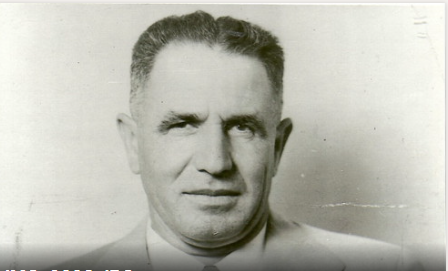
Floyd N. Cardona was born on March 17, 1899, in Italy, the son of Antonio Cardone and Maria Mazzeo. As an infant, he was brought to Rye, New York, where he was raised and educated, becoming part of the town’s growing immigrant community in the early twentieth century.
At the turn of the century, Rye was transitioning from a rural coastal town into a suburban community influenced by nearby New York City. Families like the Cardonas contributed to the town’s development, blending immigrant traditions with the evolving character of the region. He later resided at 39 Grandview Avenue in Rye.
World War I Service
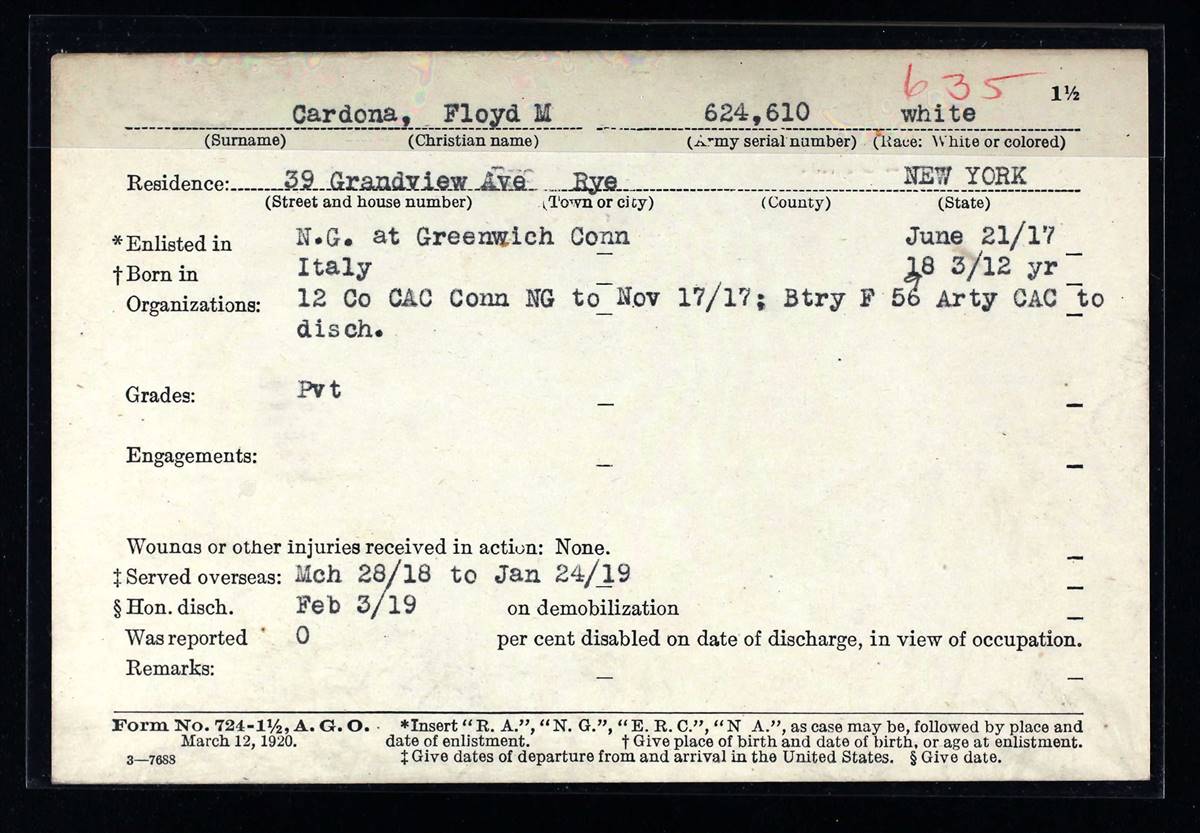
 Cardona entered military service on June 21, 1917, when he enlisted in the Connecticut National Guard at Greenwich, Connecticut. He initially served with the 12th Company, Coast Artillery Corps, Connecticut National Guard, before being transferred to Battery F, 56th Artillery Regiment, Coast Artillery Corps.
The 56th Artillery was organized on December 1, 1917, from existing Regular Army units and Connecticut National Guard companies drawn from the Harbor Defenses of Long Island Sound. After mobilization and training, the regiment deployed to France in March 1918 as part of the American Expeditionary Forces, where it served within the Coast Artillery Corps in a heavy artillery role.
 Equipped with twenty-four French-designed 155 mm guns towed by Holt tractors, the regiment represented a key element of American long-range firepower on the Western Front. Assigned to the 31st Artillery Brigade, the 56th supported both the III Army Corps and V Army Corps, delivering sustained bombardment against German positions. Its mission included counter-battery fire, the destruction of fortified defenses, and support of advancing infantry units during major offensives.
Cardona served overseas in France from March 28, 1918, to January 24, 1919, during some of the most critical phases of the war. His regiment took part in operations associated with the Second Battle of the Marne, where Allied forces halted the final major German offensive and began a sustained counterattack that shifted the momentum of the war. The 56th Artillery also supported the Meuse–Argonne Offensive, the largest American campaign of World War I, in which coordinated artillery and infantry assaults broke through German defensive lines and forced a general retreat leading to the Armistice.
As a member of a heavy artillery regiment, Cardona served under demanding and often dangerous conditions, operating large-caliber guns that required precision, coordination, and endurance. While his record indicates that he sustained no wounds in action, his service placed him within the sustained bombardment operations that were essential to Allied success on the Western Front.
Following the Armistice, the regiment returned to the United States in January 1919 and was transferred to Camp Jackson, South Carolina. National Guard elements of the unit were subsequently demobilized at Fort Schuyler, New York, in early 1919.
Cardona was honorably discharged on February 3, 1919, having completed his service as a Private.
 Life After Service
Following the war, Cardona returned to Rye, where he remained connected to the community in which he had been raised. He married Theresa C. DiPace on December 15, 1920, in Harrison, New York, and they had two daughters, including Marie Eleanor and Joan.
He went on to build a successful career as a contractor, working on major construction projects both in the United States and abroad. His work included projects in the Panama Canal Zone and later in Caracas, Venezuela, where he became a prominent figure in the city’s mid-twentieth-century building expansion.
In Caracas, he was involved in the construction of office towers and major infrastructure, including highway development projects connecting the city to its airport at Maiquetía. His work reflects the broader role of American engineers and contractors in international development during this period.
During World War II, he contributed to the war effort as a civilian working on defense-related construction projects, continuing his service in support of national needs.
In later years, he resided in Florida, where he remained until his death.
 Floyd N. Cardona died on August 13, 1978, in Fort Lauderdale, Florida, at the age of seventy-nine.
At the time of his death, he was survived by his wife, Theresa Cardona; his daughters, Mrs. Marie Eleanor Murnane of Caracas and Mrs. Joan Shuster of Fort Lauderdale; and three grandchildren.
Record Commentary: Excellent enhancement. The addition of detailed unit history, equipment, and corps-level assignments significantly strengthens the artillery narrative. Clear linkage to Marne and Meuse–Argonne with concise impact explanations meets top-tier standard. Tier Rating: A+
Veteran History & Research Links
World War I Military Record
SEARCH ALL ANCESTRY
RYE CHRONICLE
Copy and Search for: "Floyd N. Cardona" Rye NY Chronicle - When searching, consider taking out middle initial, this can improve results in some cases.
(PLEASE READ THESE IMPORTANT INSTRUCTIONS BEFORE SEARCHING FULTON HISTORY FOR NEWPAPER ARTICLES)
Previous Search Results for this veteran may be listed below

EXPLORE MORE VETERANS
MERGENTHALER, GEORGE O.
Read moreRAINSFORD, MARK
Read moreHubbard, Carol C.
Read moreRand, Lindsay
Read more