
Veteran Information
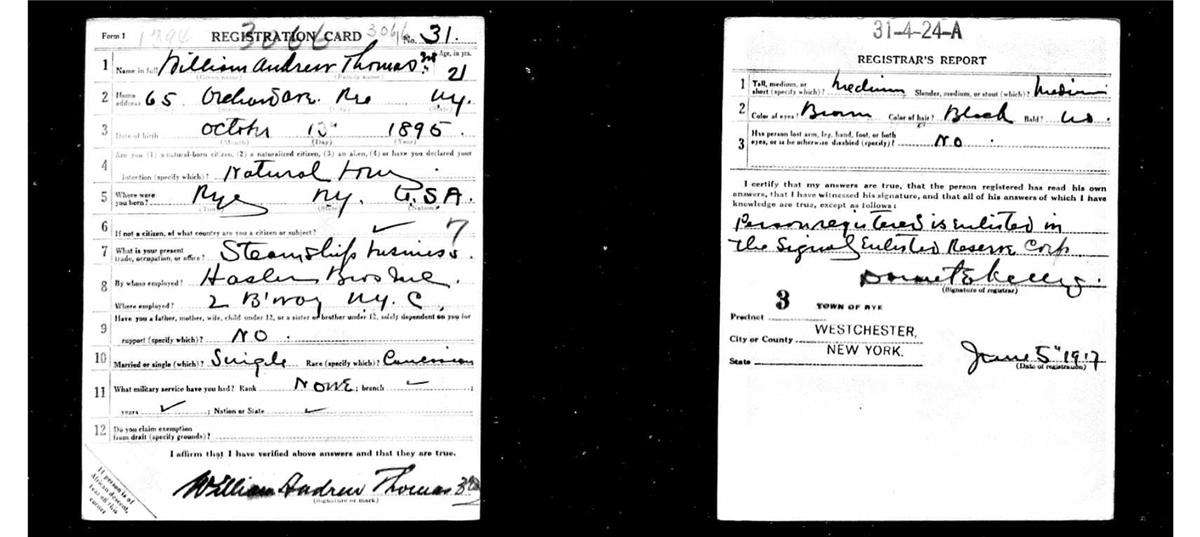
Date of Birth: October 13, 1895
Date of Death: July 1, 1982
Address: 65 Orchard Ave
Branch of Service: U.S. Army
Description
 William Andrew Thomas 3rd.
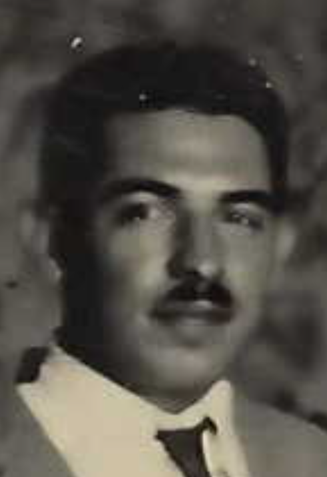
William Andrew Thomas III was born on October 13, 1895, in Rye, New York, the son of William A. Thomas Jr. and Miriam Sylvester Berry Thomas. He grew up in Rye at 65 Orchard Avenue as part of a well-established local family and was the older brother of Edward James Thomas.
By the time of the First World War, he was employed in the steamship business in New York City, working at 2 Broadway, reflecting early involvement in the transportation and shipping industries that connected New York to global trade.
World War I Service
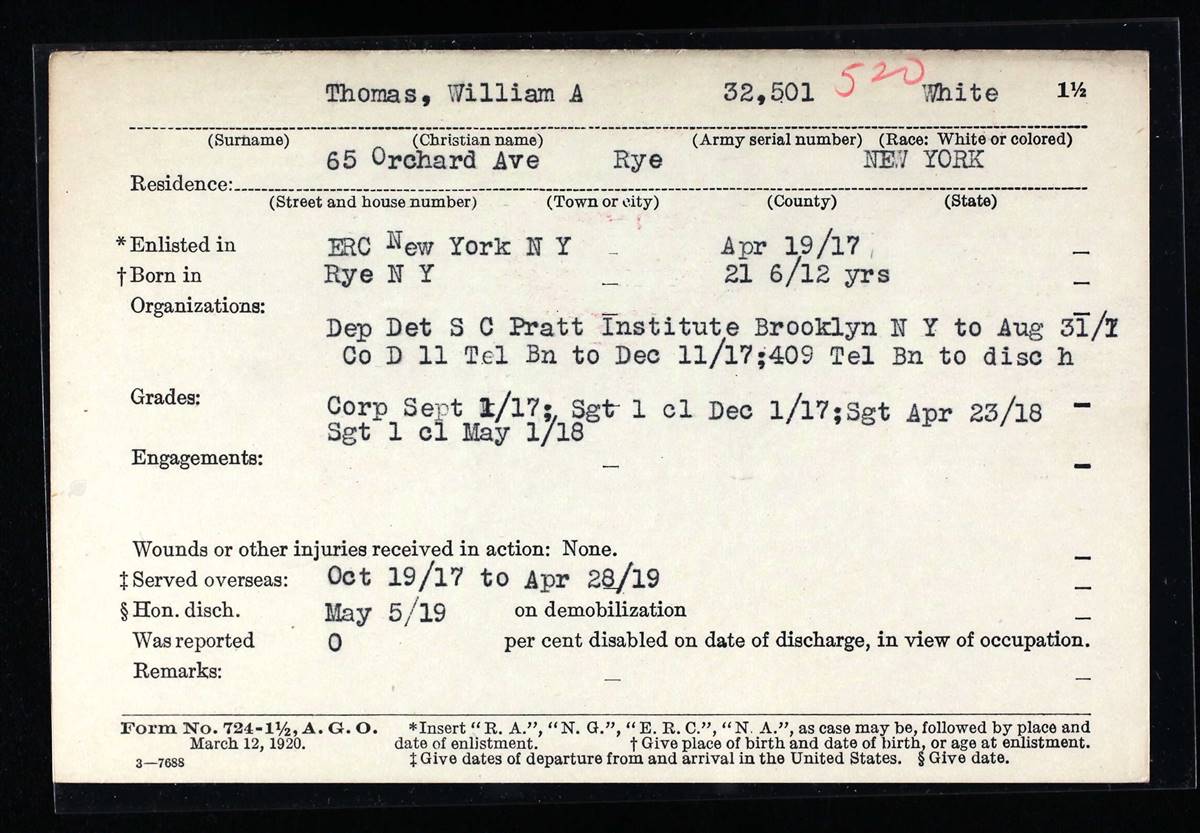
Thomas entered military service on April 19, 1917, when he enlisted in the Enlisted Reserve Corps in New York City. He was first assigned to the United States Army Signal Corps training detachment at Pratt Institute in Brooklyn, where soldiers were prepared in military communications, including telegraphy and field signal operations.
He was subsequently assigned to Company D of the 11th Telegraph Battalion, and later to the 409th Telegraph Battalion. These units were responsible for constructing and maintaining vital communication lines across the battlefield, ensuring coordination between infantry, artillery, and command elements of the American Expeditionary Forces (AEF).
Thomas advanced rapidly in rank, being promoted to Corporal on September 1, 1917, and later to Sergeant First Class, reflecting both technical proficiency and leadership within the Signal Corps.
While serving overseas in France from October 19, 1917, to April 28, 1919, he became attached to the United States Army Air Service, the aerial warfare branch of the Army during World War I.
As part of the expanding American aviation program, he trained as a pilot and earned his aviator’s wings. He was also awarded a French pilot’s brevet, indicating successful completion of advanced flight training under Allied instruction. His record notes distinction in training, including achieving a long-distance flight in notably short time’an important measure of skill and endurance in early military aviation.
The Air Service played a critical role in reconnaissance, artillery spotting, and the development of aerial combat tactics during the war. Thomas’s transition from Signal Corps communications to aviation reflects the close relationship between emerging technologies in communications and flight during this period.
He sustained no recorded wounds in action and was honorably discharged in May 1919.
Life After Service
Following his military service, Thomas married Harriet Elizabeth Marvel in 1924, and the couple raised a family that included two sons. He later pursued a career as an electrical engineer, working for the General Electric Company in Plainville, Connecticut.
He eventually settled in South Egremont, Massachusetts, where he lived for more than two decades. He remained connected to his wartime service through membership in the Aviators Post of the American Legion in New York City.
William Andrew Thomas III died on July 1, 1982, at the age of 86.
He was survived by his wife, Harriet Thomas; his two sons, William Berry Thomas and Richard Marvel Thomas; and three grandchildren.
Veteran History & Research Links
World War I Military Record
SEARCH ALL ANCESTRY
RYE CHRONICLE
Copy and Search for: "William Andrew Thomas 3rd." Rye NY Chronicle - When searching, consider taking out middle initial, this can improve results in some cases.
(PLEASE READ THESE IMPORTANT INSTRUCTIONS BEFORE SEARCHING FULTON HISTORY FOR NEWPAPER ARTICLES)
Previous Search Results for this veteran may be listed below

EXPLORE MORE VETERANS
Mc Donald, Allen
Read moreBASSETT, JOHN E.
Read moreREILLY, JOHN SHERIDAN
Read moreJennys, Shirley S.
Read more