Robert H Davidson
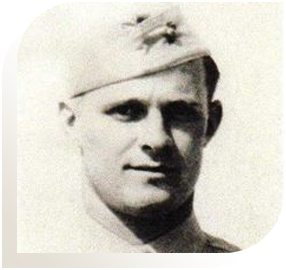
Robert H. Davidson was born in Massachusetts in 1919. He later moved to Rye with his loving family, where they rented a house at 5 Oakwood Ave for $60 a month ($1,144.52 today). His residence consisted of his father Ellis W. Davidson, his mother Mildred Davidson, his older brother Richard Davidson, and his servant Stella Simgouski. Robert’s father was a college educated man, who worked as an editor, he was making around $5,000 a year ($95,376.43 today). Robert’s mom had a high school education, and did not work.
Robert was a proud graduate of the Class of 1936. Throughout his high school career, Robert took part in many school activities, he was a member of the honor society and took honors level classes. Robert was also a stagecoach and editor-in-chief of Hitching Post. During Freshman year Robert served as the class vice president and continued his service during Junior year when he became a part of the class council. In Robert’s free time, you would often see him playing baseball and enjoying the outdoors.
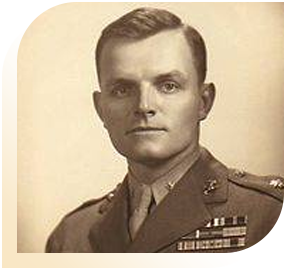
Robert’s impressive military career began in July of 1943 when he enlisted in Marine corps school, from there he was detached a captain and was assigned to the 4th Marine Division. Robert’s was one of the youngest officers in the marines to be assigned to a combat unit, he was only 24. The next year Davidson was promoted to Major and assigned as the Training Officer of the 2nd Battalion, 23rd Marines, and participated in the training phase prior to and during initial combat operations at the Battle of Saipan in 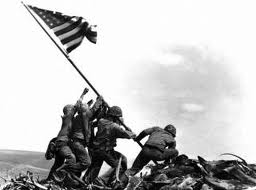 the Marianas Islands June 15-July, 1944 . On the fifth day of Saipan operations, Davidson was appointed battalion executive officer for the remainder of the Saipan battle and served in this position during the Battle of Tinian July 24-August 1, 1944. A few months later Major Davidson assumed permanent command of 2nd Battalion, 23rd Marines. He continued in this capacity until the end of the war. As the Battalion commander, Davidson was responsible for training, supply, discipline and welfare of a unit of approximately 1,000 men in garrison. As a Landing Force commander, Davidson was responsible for embarking his command aboard 6 naval attack transports. On February 19, 1945, Davidson commanded one of seven Battalion Landing Teams in the initial assault at the Battle of Iwo Jima. Davidsons command was composed of an Infantry Battalion plus attachments totaling approximately 1,800 men. He continued as Battalion Commander throughout the Iwo Jima operation.
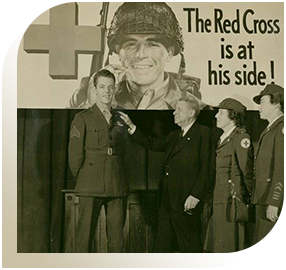
After the war Robert’s joined the Marine Corps reserve and was personally given a silver star by president Truman for his heroic actions throughout the battle of Iwo Jima. While in the reserves Robert continued towards his goal of becoming a successful businessman, and quickly he became an executive for General Foods.
Robert’s stayed with General Foods until he determined he was ready for a bigger position. Ultimately Roberts became the President and Chief Operating Officer of PVO International of Boonton, New Jersey, and San Francisco, California; soybean processors and marketers. He worked for them until retirement in 1976.
Robert Davidson died suddenly on October 10, 1982, of a coronary occlusion in Charlotte Hungerford Hospital in Connecticut. He is survived by his 1 daughter.
Austin Harvey
RHS 2021
Silver Star Awarded for actions during the World War II
“President of the United States of America takes pleasure in presenting the Silver Star to Major Robert H. Davidson MCSN: 0-7430 , United States Marine Corps Reserve, for conspicuous gallantry and intrepidity as Commanding Officer of the Second Battalion, Twenty-third Marines, FOURTH Marine Division, in action against enemy Japanese forces during the assault and capture of Iwo .jpg) Jima, Volcano Islands, from 19 February to 16 March 1945. Landing with the initial elements of his unit amidst heavy hostile mortar, artillery and small-arms fire on 19 February, and confronted with an enemy strong point which threatened to place his Battalion in an extremely disadvantageous position during the night, Major Davidson cleverly maneuvered his assault units to high ground from which he was able to render the position of the Japanese untenable and, later, personally supervised the reduction of this area of resistance. Although suffering from severe wounds as a result of enemy rocket fire and having lost all the key personnel of his staff while his Battalion was leading the assault of the Regiment, Major Davidson refused to be evacuated and continued to control his unit, until ordered by the Regimental Commander to relinquish command. His keen tactical judgment and courageous devotion to duty were in keeping with the highest traditions of the United States Naval Service.”
Jima, Volcano Islands, from 19 February to 16 March 1945. Landing with the initial elements of his unit amidst heavy hostile mortar, artillery and small-arms fire on 19 February, and confronted with an enemy strong point which threatened to place his Battalion in an extremely disadvantageous position during the night, Major Davidson cleverly maneuvered his assault units to high ground from which he was able to render the position of the Japanese untenable and, later, personally supervised the reduction of this area of resistance. Although suffering from severe wounds as a result of enemy rocket fire and having lost all the key personnel of his staff while his Battalion was leading the assault of the Regiment, Major Davidson refused to be evacuated and continued to control his unit, until ordered by the Regimental Commander to relinquish command. His keen tactical judgment and courageous devotion to duty were in keeping with the highest traditions of the United States Naval Service.”
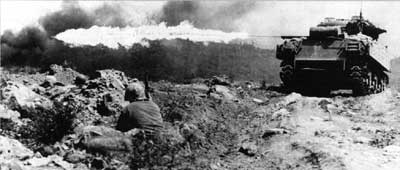 The American invasion had the goal of capturing the entire island, including its three airfields (including South Field and Central Field), to provide a staging area for attacks on the Japanese main islands. This five-week battle comprised some of the fiercest and bloodiest fighting of the War in the Pacific of World War II.
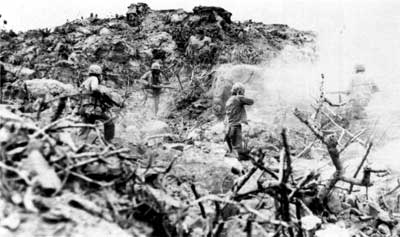 This included taking the highground of Hill 362 and Nishi Ridge.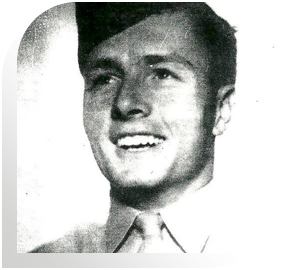
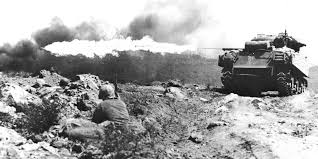 Tanks and half-tracks were employed effectively against enemy cave positions in the center. CT 26 CP displaced forward. At 2100 a counter-attack of undetermined size appeared to be developing on the front of LT 226. This activity was reported broken up at about 2120, after artillery and rocket barrages were brought down.
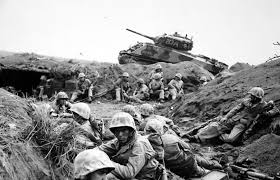 The marines attacked again on D+13 against a front swept by machine gun and rifle fire from a new line of caves and tangled underbrush. The attack was sluggish and the Japanese seemed to sense it, two or three times forming groups of 200 or 300 for counterattacks which were promptly broken up by artillery and mortar fire.
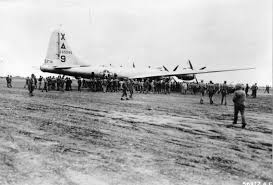 This day 4 March 1945 was described as the unsuspected turning point on Iwo Jima. That afternoon the first crippled